
VABEs
What They Are and Why They Are Important
Walking down the beach at Asilomar for a conference of Organizational Behavior scholars, Ed Schein from MIT gave me my first glimpse of VABEs. We were discussing culture and more broadly why people do what they do. He referred to Meso-American pyramids, which he noted, were physical artifacts from a former culture. Then, he noted that even though we cannot observe them, we know that they conducted human sacrificial rituals on those pyramids. Rituals in which priests would lay the individual to be sacrificed on a convex- arched altar and then using a razor-sharp obsidian knife cut the person open and remove various organs. Sluices on either side of the stairway drained away the blood to the bottom where the populace raptly watched.

Then Ed gave me the punch line: Why? Why would people do this? Clearly the answer was because of their shared beliefs that the gods had sacrificed themselves to create the world and therefore required human sacrifice to repay the debt and ensure health, virility, good harvests, solar stability, and so on. Human blood was believed to be the life force essential to a continuation of the very world.[i]
Today, we know that these beliefs are an inaccurate view of the world and universe. The Aztec and Mayan cultures have faded away and been replaced with different cosmologies and religions—most of which continue to hold central an omnipotent creator.
That conversation with Ed Schein hit me hard and deep. Reading widely since then including researchers like Albert Ellis and Edward Deci I wrestled to formulate some kind of integrated view of why people behave the way they do.
My model evolved to settle on a three-layer perspective. Level One was physical behavior, the things that people say and do that can be captured on film.
Level Two was Conscious Thought. We think. We know that we think. We choose not to reveal everything we think to others at Level One. Sometimes our private thoughts “leak” to Level One in the form of a sigh, a shrug of our shoulders, a frown or rolling of our eyes.
Level Three, the “why”, became our semi-conscious Values, Assumptions, Beliefs and Expectations about the way the world IS or SHOULD BE. VABEs for short. I say semi-conscious because our VABEs are so much a part of us, we are often not aware of them, to us they just are the way things are.
Recently, the work of Amos Tversky and Daniel Kahneman have demonstrated the primacy of our semi-conscious beliefs. In Fast Thinking, Slow Thinking Kahneman described what he called System 1 and System 2 thinking.[ii] System 1 was the “system” we use to jump to conclusions quickly. System 2 was a slower, more reasoned process that we use to rethink logically our cause-and-effect linkages. Malcolm Gladwell explored this phenomenon in his book Blink.[iii] Kahneman later got a Nobel Prize for his work and the idea that the vast majority of people trust their beliefs (VABEs) OVER reliable, solid evidence. The evidence for this lies in the perpetuation of the world’s religions and tribal cultures. So, while the ritualistic violence of the Meso-Americans no longer exists, it has been replaced by lingering and intense beliefs in an invisible Creator. I say “intense” given the historical evidence of religious warfare.
Richard Dawkins in his book The Selfish Gene introduced the idea of memes.[iv] (pronounced meems). Genes, he noted were physical packets of information passed on from one generation to the next. Memes, he said, were intangible packets of information passed on from one generation to the next. Like genes express in the evolutionary process, memes too could persist or wane in a culture.
Richard Brodie in his book The Virus of the Mind, identified three kinds of memes: association or name memes, distinction or value memes and strategy or instrumental memes.[v] Name memes give identity to something. “France” is a place, so is “Alabama.” “Kindness” is a good thing while “murder” is not. And instrumental memes had the form of If-Then statements like “If you do this, that will happen.”
How are VABEs different from Memes?
I developed the concept of VABEs because the term lends more immediate association with the four concepts than the more generic memes. Yes, there are value memes. And expectations could be seen as strategy memes. And beliefs and assumptions could be seen as association memes. For me, VABEs implies more specificity and adds a emotional component.
In his book Choice Theory, Bill Glasser declares that there are three common beliefs worldwide.[vi] What parent does not believe with regard to their new-born child:
- I know what’s right for you.
- I have a right even a sacred responsibility to tell you what’s right for you, and
- I have a right even sacred duty to punish you if you don’t do what’s right for you.
This, as Alice Miller describes in her book The Drama of the Gifted Child, every newborn baby immediately gets two gifts: a set of genes and the memes/VABEs of their caregivers.[vii] Worldwide parents and caregivers are continuously imbuing, can we say programming?, their children with their own beliefs/memes/VABEs/Values/Assumptions/Beliefs/-Expectations about the way the world is—or should be. They teach children what to read, what to memorize, what’s acceptable and what’s not acceptable. The best predicter of a person’s religion is where they were born. Yes/no?
Children who disobey are treated in a variety of ways including ostracism, disownment, excommunication, slander and even death. Yes, parents whose children have misbehaved have even been murdered—by their own parents. Because they violated “God’s law”, or brought shame upon the family name, or married outside the “true” religion.
What VABEs did your parents teach you?
I invite you dear reader to spend a few minutes contemplating what VABEs (or memes if you prefer) your parents taught you. Write them down. Do you still conform to those VABEs? Have you thought about which of those you want to KEEP, LOSE or ADD to your world-view?
This brings us to the work of Mihalyi Csikszentmihalyi, a Polish social scientist who worked at the University of Chicago. You may have heard of him for his book Flow. Another of his books, The Evolving Self, I found equally stimulating.[viii] In it he asks what I have come to think of as the most important question in life:
Will you ever be anything more than a vessel transmitting the genes and memes (VABEs) of the previous generation on to the next generation?
The author concludes, and I agree, that the answer for the vast majority of people is “no.”
What is an “adult?”
Adulthood is not something that comes naturally with the passage of time. Legal systems may declare age 18 or 21. The age of consent is usually much lower—in one of the sad ironies of the global legal system. Is a 55 year old person an adult? Is a 22 year old person and adult?
It seems to me that an adult is a person who has contemplated and examined carefully the various VABEs he/she/they were taught as a defenseless child and chosen which to Keep, which to Lose and which to Add to their worldview. Short of that, a person is just a vessel transmitting yesterday into tomorrow. How many people live their entire lives and never question what they had been taught as a child? Ellen Langer’s work at Harvard has focused on living “mindlessly.” What does it mean to live “mindfully?” To live searching for and contemplating new evidence?
How We Think
How one thinks at Level Two is a critical consideration. Given the above, most people are Deductive Thinkers. They begin with their VABEs about the way the world is and then filter incoming information to match their VABEs, discarding or ignoring contradictory information. Inductive Thinkers begin with observations, inviting new evidence, and adjust their VABEs to fit the data. Two opposing ways of thinking.
Changing one’s VABEs, what I call “working at Level 3”, is not easy. Consider Thomas Kuhn’s book, The Structure of Scientific Revolutions,[ix] in which he describes how major paradigm shifts like from Ptolemy’s geocentrism (the sun revolves around the Earth) to Copernican heliocentrism (the earth revolves around the sun). Then later, he explores the revolution from Newtonian physics to Einsteinian relativity. In both cases, one a long time ago and one much more recent the transition to “general acceptance” took roughly 30 years. 30 years! In other words, the old scientists had to literally die off for the new scientific evidence to be generally accepted—even among the trained scientists of the world! VABEs. We all have them. And they dominate our thoughts (Level 2) and behavior (Level 1).
Albert Ellis in his book A Guide to Rational Living, described how we might diagram the process of human thinking and behavior.[x] He called his system “Rational Emotive Behavior.” It’s a model designed to show how people in therapy can be considered to be utterly rational—given their VABEs.
People see things. In a micro-second (Blink or System 1) they compare their observation with what their VABEs expect, and they make/jump to conclusions about what they saw. Is it “right?” “Wrong?” “Good?” “Bad?” etc. Those conclusions elicit emotions which in turn shape our behavior. Do we sigh? Groan? Growl? Shout? Smile? How do we manifest our assessment of what happened/was observed?
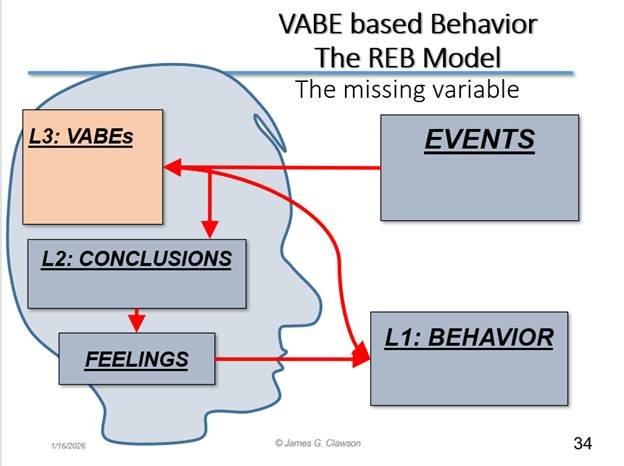
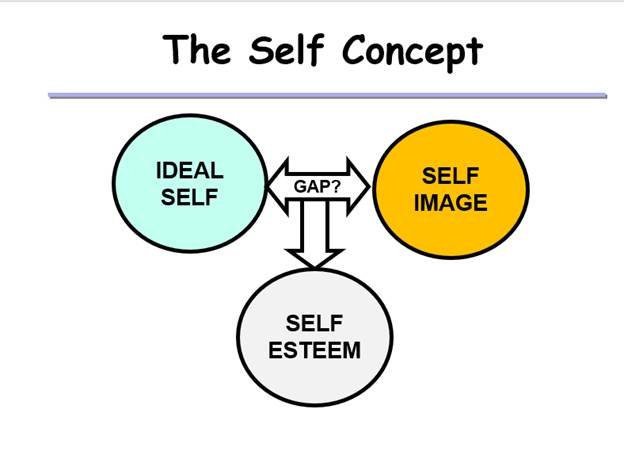
Note in the diagram that we can also “observe” our own behavior. And we similarly judge our own behavior against our own VABEs. We may feel good about what we’ve done or not. We add what we think about ourselves and match that against the feedback we get from others and that compilation affects our Self-Concept, particularly our Self-Esteem. What we “want” is based on our VABEs like “I should be a patient parent.” Or “They should obey me.”
Given the narrative above, I assert that “it’s all about VABEs.” That to understand a person we need to engage at Level 3 and strive to see, to clarify, to understand their semi-conscious VABEs. Further that culture is a set of shared VABEs and that in any culture, the transmission of the culture’s VABEs begins at birth when caregivers teach and behave. Ed Schein once came to my university and walked around for an hour and then delivered an accurate description of our school’s culture—by making inferences about the visible artifacts he could see. Geert Hofstede’s work notwithstanding, culture is a set of shared VABEs.
A colleague recently tried to identify the VABEs that characterize the American culture to which Americans would agree. She offered the following: Life Itself, Equal Rights, Free Speech, Rule of Law, Democracy and Truth. What do you think of that summation? An alternative less laudatory description might be Wealth is Power, Might is Right, Cheat if you must to get Wealth, Christian Nationalism, and Science is Suspect.
Only when an executive “sees” their organization’s (or nation’s) culture as a set of shared VABEs can they begin to think about what or which aspects of that culture “should” be modified or changed. Ayaan Hirsi Ali wrote in her book Infidel: My Life about growing up in a strict culture which included (sadly) female circumcision.[xi] Which is a horrible (I say) mutilation of a woman’s body. And is still tolerated and encouraged in 23 nations today. Why? VABEs. It’s all about VABEs. If you were the president of a nation, how would you go about setting your strategic agenda?
Obey or Assert?
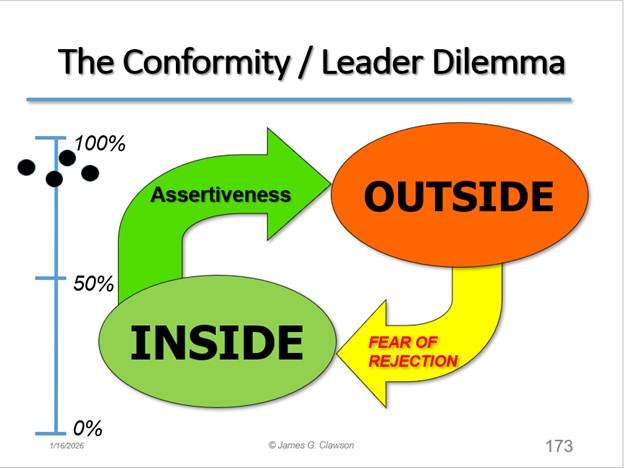
This brings us to another major dilemma, the balance we all live between conforming to expectations of others or asserting another perspective. Why do people in a culture conform, that is obey? They do this to avoid the criticisms/consequences that come (outlined above) with disobedience. That is when we live “outside-in” (OI) we are conforming to the expectations of others – because we fear their judgments. Some cultures, like Ali’s, are stricter than others. Note, though, that conformity is essential to any civilization. Without conformity, we have chaos. So, living outside-in is not a bad thing. Until it is.
We also live somewhat “inside-out” (IO) asserting our point of view on others. The question I have is “what’s the balance between your OI and your IO?” Without IO there is no innovation, no creativity, no willingness to change, no challenges to the VABEs of the previous generation and its proponents—even in the scientific communities. Do you ever wonder ”How old does one have to be before they can say what they think?” Young people often live more OI; they were trained to do so. Older people (not necessarily “adults”) are often revered and deferred to—even when they are resisting those who live more IO.
What is your OI/IO balance? How much do you censor yourself to “fit in?” When and where do you feel free to speak your mind? Most of the senior executives I’ve met over the last sixty years felt very comfortable imposing their views on those around them. (Black dots in the diagram) That’s why they became executives. When though does confidence become ego-centric narcissism? When is ego-centricity justified? Or not?
Brain Chemistry
Is leadership genetic? Is narcissism genetic? Is your OI/IO balance inherited? Our human brains contain some 100 billion neurons weighing together about 12 pounds. Each neuron can connect to 10,000 other neurons. That’s one quadrillion synapses. Add to that mass some 300+ known chemicals/hormones and the human brain is an astoundingly complex thing. David Eagleman’s book The Brain explains a lot about our thinking machine.[xii]
Get a little too much of one hormone or a little too little of another or limit the oxygenation at birth and you might get any one of the 300-600 identified patterns or syndromes. These include things like depression, obsessive compulsions, attention deficits, hyper-activity, schizophrenia, bipolar disorder, addictions etc. John Ratey at Harvard published a book, Shadow Syndromes, describing how the mild, moderate and major manifestation of these various patterns affect our daily lives.[xiii] Scientists continue to study the brain from a variety of perspectives.
Conclusion
This brief article summarizes some of the major influences on human behavior. Each of the concepts introduced above continues to be the target of on-going research. The typical lay-person is not likely to follow that research—yet they demonstrate many of the tentative conclusions drawn here. What about you? What are your core VABEs? Have you examined them lately? Ever? Will you be one of the billions who live and die simply perpetuating their childhood lessons? Or will you as Csikszentmihalyi invites, rise above, transcend your childhood programming? Will you become an adult? Are you a Deductive or Inductive Thinker? How much do you live OI versus IO? What will be your legacy as time passes?
[i] https://www.perplexity.ai/search/why-did-mesoamericans-sacrific-OubAZD3JR8OgCB2vAY92zg
[ii] Kahneman, Daniel, 1934-2024, author. Thinking, Fast and Slow. New York :Farrar, Straus and Giroux, 2011.
[iii] Gladwell, Malcolm, 1963-. Blink : the Power of Thinking without Thinking. New York :Little, Brown and Co., 2005.
[iv] Dawkins, R. (1976, 2006). The Selfish Gene (First and Thirtieth Anniversary Editions). Oxford University Press.
[v] Brodie, Richard, The Virus of the Mind, Hay House inc/ltd, 1995.
[vi] Glasser, W. (1999). Choice theory. HarperPerennial.
[vii] Miller, Alice, The Drama of the Gifted Child, Basic Books, 2008.
[viii] M. Csikszentmihalyi, “The Evolving Self: A Psychology for the Third Millennium,” Harper Collins Publishers, New York, 1993.
[ix] Kuhn, Thomas S. The Structure of Scientific Revolutions. 4th ed., The University of Chicago Press, 2012.
[x] Ellis, A., & Harper, R. A. (1961). A guide to rational living. Prentice-Hall.
[xi] Ali, A. H. (2008). Infidel. Simon & Schuster.
[xii] The Brain: The Story of You. David Eagleman, Canongate (2015).
[xiii] Ratey, John, Shadow Syndromes, Random House, 1998
