
I have long since been interested in what people have learned in their lives. I’ve asked several professional groups to share theirs–and been surprised at how many people either a) haven’t thought about and don’t want to and b) don’t want to share their insights with others. A couple of people have said that sharing their pearls of insight would be like “casting their pearls before swine.” (Matthew 7:6)
My response is “why would you work and struggle as hard as you did and not want to share your insights with others and take your learnings to the grave with you?” And who says the rest of us are “swine?”
Anyway, I’ve thought about this question and here are mine. Perhaps you will share yours with the rest of us???
VABEs, Evidence and Evolution
James Gordon Schlafke Clawson
Johnson and Higgins Professor of Leadership and Organizational Behavior, Emeritus, UVA Darden School of Business
78 as of this writing
VABEs
I first glimpsed the concept of VABEs walking down the beach at Asilomar California talking with Ed Schein (from MIT and one of my heroes in life). Ed described the Meso-American pyramids as artifacts, physical remnants of ancient cultures. Then, he noted the now invisible rituals those ancient peoples performed there, human sacrifices. But the real question he noted was “why?” Why did they do that?
The obvious answer was that they believed that the gods demanded human sacrificial blood to “bless” the people with rain, good harvests, and good fortune generally. Ed emphasized the importance of the why question and its answer.
Years later, I reconstituted this lesson into what I called three levels of human behavior. Level One was the visible, what one can capture on film. Level Two was conscious thought. We think. We know we think. And we know we don’t reveal everything we think at Level One speech and behavior. Imagine the consequences if we all had an electric news feed on our foreheads showing what we were thinking. Level Three then consisted of our semi-conscious Values, Assumptions, Beliefs and Expectations about the way the world is or should be. Semi-conscious because many of these VABEs were so much a part of us that we don’t even see them. Sometimes these VABEs leak to Level One in a sigh, a frown, a shrug, a snort or even laughter.
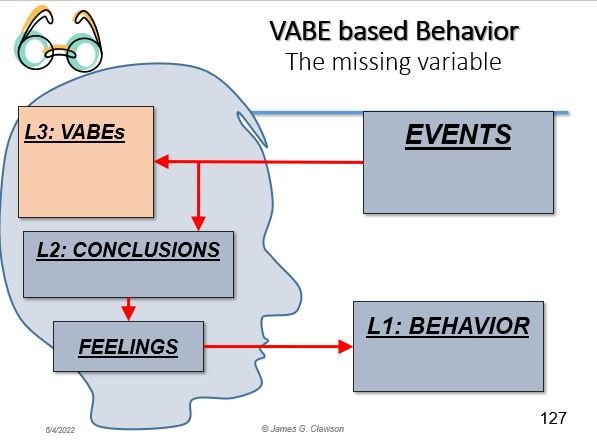
This reconstitution flowed from widespread reading of various scholars, psychologists, and theorists. Albert Ellis’s model of human behavior (A Guide to Rational Living) put assumptions about the world at the very core of behavior. He called this model the Rational-Emotive-Behavior model or REB. This model has been extra-ordinarily powerful in describing why people do what they do in my consulting work worldwide. The implication of Ellis’s approach is that everyone considers their behavior to be “rational”—given their VABEs. Much of individual therapy is focused on identifying VABEs and challenging their functionality.
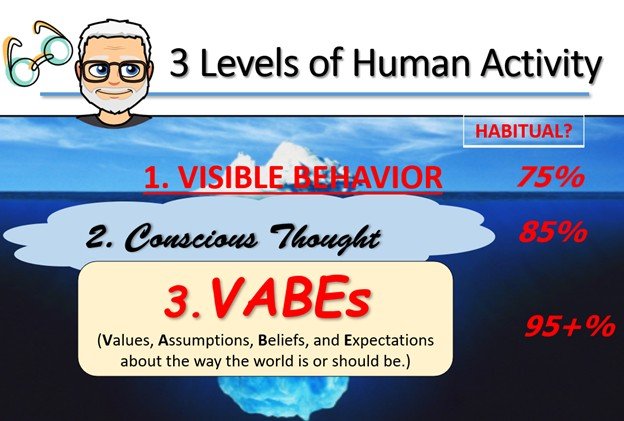
I’ve asked 2,000+ executives on six continents how much of human behavior they have come to believe is habitual—mindlessly repetitive. Overall, their answers were ~75% for Level One, 84% for Level Two (“In your experience how much of the way people think is habitual?”) and 95+% at Level Three. Vast evidence for this assertion lies in the persistence of the world’s religions and tribal cultures.
Some people ask, “How are VABEs different from Memes?” as developed by Richard Dawkins (The Selfish Gene). Genes are physical packets of information passed on from one generation to the next. Memes are intangible packets of information passed on from one generation to the next. VABEs add some specificity to the concept of memes and suggest the emotional content as included in Ellis’s model. Further, given the level of habituality of all three levels, leaders, partners, anyone actually who wants to understand human behavior should be watching for the iceberg tips of people’s VABEs as they appear in speech and behavior.
In my view, culture is a set of shared VABEs. Every newborn child worldwide is born into the culture of their caregivers. Utterly defenseless, they immediately begin to be “taught” the caregivers’ culture. First, they get a set of genes and then almost immediately a set of VABEs about the way the world is or should be. William Glasser identified three VABEs that every parent worldwide shares. 1. I know what’s best for you. 2. I have a right/sacred responsibility to teach you what’s right for you. And 3. I have a right and responsibility to punish you if you don’t do what’s right for you. (Choice Theory)
Eventually, I concluded “It’s ALL about VABEs.” If one wants to understand why people do what they do, the answer lies in their VABEs. “What must they believe to do/say that?” At the same time, clarifying one’s own VABEs is not necessarily a simple task. We can write many of them down. Others may take outside help to “see.” Learning how others see us can be difficult and challenging—most if not all of us have blind spots.
When you see someone doing something perplexing or rude or crazy or annoying, remember their behavior is rational to them. Your task is to ferret out their VABEs and comparing them with your own, strive to find a pathway to cooperation. Depending on the strength and depth of both parties VABEs, that may not be possible.
EVIDENCE
We members of the homo Sapiens race are so-named because we are (supposedly) wiser and smarter than our homo ancestors (like Erectus, Habilus, Ergaster, Neanderthalensis, Australopithecus, etc.). The “rational” Sapiens brain would and has made observations of natural phenomena and drawn conclusions that led to fire, wheels, tools, stone masonry, arches, and thousands of other discoveries. We looked up at the stars and formed hypotheses about them. Many of our ruminations about things we didn’t understand were attributed to various “gods”–supernatural beings that we believed had major influences on our lives and the world around us.
Our various conclusions about the nature of things often offended people in other groups. Conquests and wars emerged. Religions (god beliefs) fought against religions. Empires emerged formed by powerful conquerors like the Khans, Suleiman, Alexander, Caesar, Cortez and others.
Much later, two Harvard Business School scholars (Paul Lawrence and Dean Nitin Nohria) concluded that there were four basic, instinctive human drives: to acquire more, to protect what one has acquired, to create, and to procreate. Large swaths of human behavior historically can be explained by these four drives.
More recently, Amos Tversky and Daniel Kahneman and associates conducted experiments to explore human decision making. Kahneman’s book, Fast Thinking, Slow Thinking, was significant in his receiving a Nobel Prize for the idea that most people trust their beliefs (VABEs) OVER solid, reliable evidence. Thomas Kuhn’s book, The Structure of Scientific Revolutions, traced the major scientific paradigm shifts. He noted that they tended to last thirty years—one generation. Even among trained scientists, collectively the smartest of Sapiens, the old generations had to die off before a new set of VABEs about how the world is could be widely accepted.
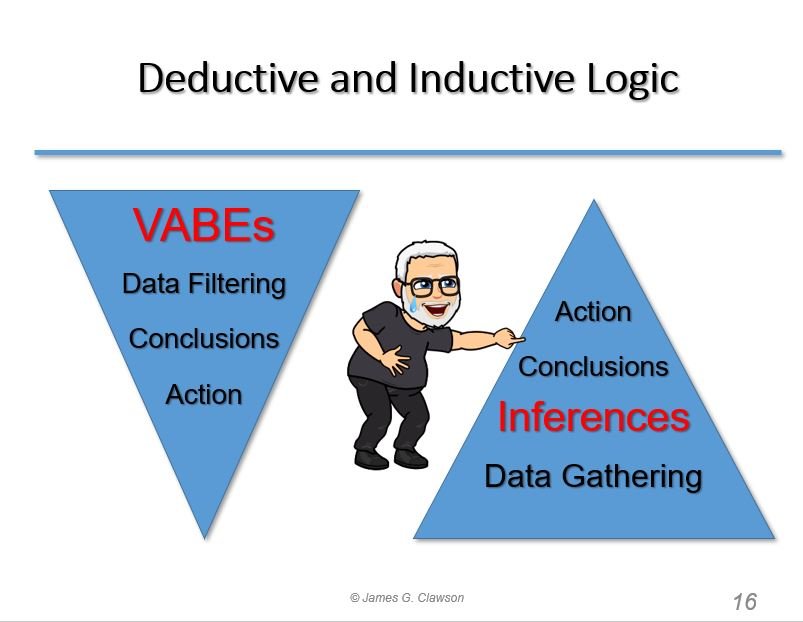
Again, the evidence for this phenomenon is everywhere visible in the persistence of the world’s (various) religions and tribal cultures. Most people tend to think deductively, beginning with a premise and filtering information (the confirmation bias) to fit their premises. Far fewer people think inductively beginning with repeated and reliable observations and building toward logical conclusions. Malcolm Gladwell repeated this theme in his book Blink. Once again, it’s all about VABEs.
The implications for parents, leaders, politicians, writers, teachers, and everyone are legion. How quickly do we judge others? On what basis? How open are we to contradictory information? Will we grow as we age? Or will we simply become, as one colleague defined aging, “more so” Yes, people can change, and in my experience, the odds are low. What do you observe at your family reunions? How many people live and die without learning, just passing on their VABEs onto the next generation? Csikszentmihalyi, the describer of flow outlined this far too common process in his book The Evolving Self.
Can we trust science? Do vaccines work? Is relativity a real thing? What about the weird world of quantum physics? Science is based on several VABEs which include the following:
- One makes observations in the world.
- One draws tentative logical hypotheses from those observations.
- One designs experiments to test the hypotheses.
- One publishes one’s results describing everything transparently so others can review and replicate to confirm.
- One remains open to the possibility that future research will affect one’s work.
Science generally has been under attack in recent times. Information in medicine, meteorology, physics, astronomy, and many other fields have come under scrutiny and distrust from politicians, leaders, and average hard-working people. The mass communication channels available to us now make rumors and conspiracy theories much easier to propagate. Wise homo Sapiens will check their channels of information and the very information they receive for verifiability and engage in more slow thinking based on solid, reliable evidence.
EVOLUTION
I was raised in a god-fearing home. (see above) My maternal grandmother was the wife of a Baptist pastor. My mother took me and my father to church on the major holidays. When I was 12, she divorced my father and married a Mormon. After being taught, we became devout believers. I spent 35 years in devotion, praying daily several times, reading and re-reading the scriptures, served 30 months proselyting in Hong Kong and Japan, became a Branch President and a Stake President (8 units, 3,200 members). Then at age 48, my mental “shelf” of questions got so heavy it broke. The “worldly evidence” became too large to ignore. My desire to know “the way things are” superseded my beliefs. “God’s ways are higher than man’s ways” (Isaiah 55) was no longer a sufficient answer for me. I wondered why an omnipotent, omniscient loving Father in Heaven would create a world with severe birth defects, religious animosity and cruelty, and mental illness. Two of my family members had paranoid schizophrenia and really didn’t have much of a chance in the world. It seemed so very unfair.
Suddenly bereft of most of my VABEs, I began reading widely including things that my religious leaders had said not to read. I engaged in “zero-based budgeting” for my beliefs. I read for twenty years. Psychology, astronomy, physics, philosophy, history of religions, sociology, and much more. I’d traveled and worked on six continents and had observed the people there. I learned that no child is born a believer—they are all taught by their caregivers what to believe. I noted that where a person was born was the major predictor of their religious beliefs. I felt duped by my local culture.
That despite being fortunate enough to attend and graduate from three great universities: Stanford, BYU, and Harvard. (AB, MBA, DBA) Throughout that education, I maintained and fed my faith. Until I couldn’t.
If God did not create birth defects and mental illness, what did? I am not a geneticist and what I learned was that in evolution the DNA and RNA copying processes were/are not perfect. Little mistakes are made. Some of the resulting characteristics were helpful for survival and others were not. Darwin showed that over time, some species died out and others thrived. Amidst climate changes, natural disasters (like Krakatoa’s ginormous eruption, the Yucatan asteroid and the Russian lava flows), and human voraciousness only those species that were well suited to their environments survived. (We ate all of the sloths, mammoths, and dodos.)
Darwin’s ideas were not and are still not well received in religious communities. Books on evolution are here and there banned in schools and treated as “Satanic.” Most children are taught the local religious traditions and discouraged from reading material that challenges Creationism.
This reality became more and more evident to me the more I read and traveled for work. Devotees in all regions believed deeply in their faith and claimed confirmatory feelings as evidence of divine inspiration. Eller (in Natural Atheism) noted that every child is born without religion or faith and are then taught what to believe. Science in those homes often takes a back or non-existent seat. Further, if we are to accept one devotee’s feelings as evidence, we had to accept everyone else’s feelings as evidence as well. It occurred to me that most people worldwide either won’t or can’t read Hawkings, Newton, Dawkins, Armstrong, and others who write from an evidentiary point of view.
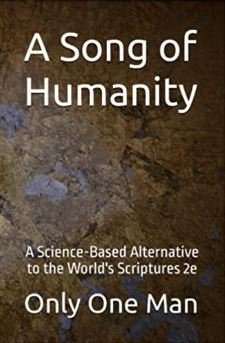
Eventually, I wanted to provide a science-based alternative to the various competing world scriptures that perpetuated their regional traditions and beliefs. So, after those 20 years of exploration, I wrote A Song of Humanity: a science-based alternative to the world’s scriptures. Yes, I know, it’s a big (arrogant?) deal; who does that? I thought it would take five years to write; in the end, it was eight months full time.
The table of contents goes like this: Genesis, Exodus, Gods, Prophets, Conquerors, Rights and Laws, Genes, VABEs, Intelligence, Mating, Children, Self, Families, Proverbs, Matter, Air, Water, Money, Culture, Apocalypse, Revelations, Index, References (20 pp), Endnotes (900+). The story is couched in a conversation between parent and child—going back to the notion that defenseless children are indoctrinated by their local cultural beliefs.
One big issue in writing was if so many billions of people believe in God(s), what does their faith do for them? If one challenges faith with evidence, what do believers lose? Hope for a better next life? Someone to talk to about their problems in prayer? What then is the purpose of life? I conclude that above all, I wanted to know the way things really are and that knowledge had to be based on reliable evidence. Personally, I find no comfort in believing in things that don’t exist. I concluded after that 20 years, that it is an evolved world/universe. And the more we can learn about it, the better off we will be.
I posted my life’s work on a website I built. (Learning how to do that was fun!) If you want more, the URL is www.level3leadership.com. Wherever you are and whatever you do, I wish you the best in this world/life. I think that means creating your personal charter: an inspiring purpose, (mine is to help people find themselves), visions of what you want to create, sorting your VABEs into keep, lose, add, a strategy for each vision, and short-term measures of progress toward your vison(s). Buena Suerte.
