
What factors influence students’ learning in class? What are the common teaching techniques? Which techniques are more effective and why? In my view, “teaching” is better described as “facilitating learning.” If we aren’t doing that, what’s the point?
MY PRIMARY GOAL for each and every CLASS: CREATING THE “BUBBLE”
~60 VIDEO CLIP Explanations of teaching concepts
See footer for LANGUAGE TRANSLATOR

For a more detailed and complete discussion of these questions, see my book with Mark Haskins on Teaching Management published by Cambridge University Press. Mark and I both taught at the Darden Business School at the University of Virginia and were convinced that the case method is a superior method of facilitating learning because it:
- Puts real situations that students will encounter in front of them,
- Gets students very actively involved instead of passively listening,
- Requires students to present their opinions in the courtroom of peers,
- Teaches them about a variety of industries and companies,
- Requires students to gather information and form opinions,
- Develops students’ judgment and wisdom.
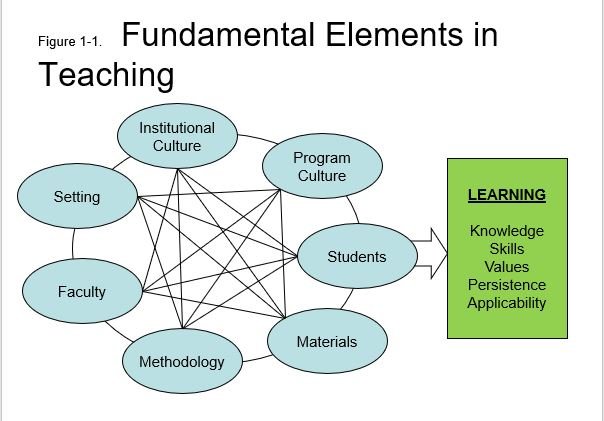
This diagram shows the various elements that influence classroom learning:
- The background/experiences of the students that enrich each other,
- The physical setting of the classroom affects everything,
- The instructor’s VABEs about learning affects how they teach,
- Especially what method/technique they use to teach,
- And what materials they choose to give the students,
- All of this amidst a program structure/expected culture,
- And amidst the expectations set by the institutional culture.
Learning of course has many facets: knowledge, skills, VABEs, decision-making, persistence, and more. Proponents of Neuro-linguistic Programming (NLP) assert that people have preferred and differentiated learning styles. These include visual, audial, and kinesthetic learners. That assertion implies that effective instructors will include diagrams, stories and exercises in their classes so that they might engage those three types of learners. Gardner suggested eight kinds of intelligences, another layer of complexity for instructors to consider.
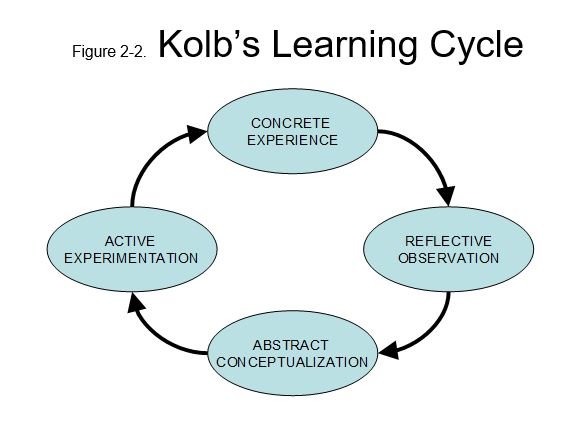
Meanwhile, David Kolb proposed a cyclical model of learning in which people had an experience, reflected on it, drew a tentative conclusion, tried it out in practice — which generated another experience. How should teachers account for that as well? Teaching, the facilitation of learning, is a complex and extremely important process in human development. Many caregivers (parents) use a Level One approach of rewards and punishments. Some use Level Two logical and rational techniques. Regardless, the children are forming their VABEs about the way the world is or should be, learning often the opposite of what was intended.
Here’s a link to a simple Excel file that will chart your LSI profile once you have the data.
One short example. Our son loved to play video games to the point that we said he had to read for an hour before each hour of video games. That summer he read 90 books! We were elated and proud. However, now as an adult he doesn’t read but he is still playing video games.
Link to Short free “wiki-cases” that anyone can use anywhere You can download these short 1-4 page cases for your classes. These were all submitted from various sources world-wide so I assume no responsibility for their accuracy. I created the wiki-case project to aid instructors worldwide who could not afford the vetted and released cases at Harvard, Darden, Ivey and other case collections. You can browse the cases first by category and then by title and then download the ones you want to use.
