
I wrote this book (published by Business Expert Press in 2021) to summarize the ~140 concepts in my week-long seminars on Level Three Leadership taught worldwide on six continents. The intent was to present in short, readable 3-4 page chapters each core concept, provide a definition, example, visual diagram and some questions for further reflection–no extraneous verbiage. In this way, readers can browse the Table of Contents and choose what concepts they want to pursue. (Here’s a link on Amazon.)
Table of Contents (Click HERE for a page of video clips of me explaining various concepts)
Section I Basics: Preface, Leading Strategic Change, Levels of Human Behavior, The Leadership Point of View, Seeing What Needs to be Done, Understanding All of the Forces at Play, The Courage to Act, Leadership and Problems, What’s a “Problem?”, The Problem with Problems, Leader as Creator, Power and Leadership, The Diamond Model of Leadership, Choice and Obligation, Inside-Out or Outside-In, Buy-In.
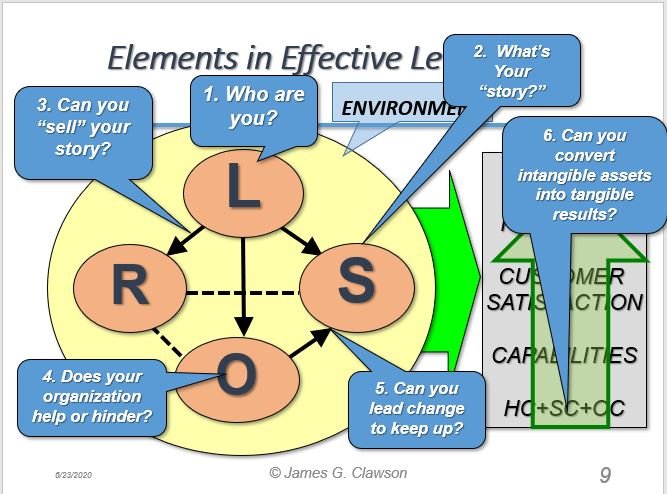
Section II: Who Are You?: The Northern Ball: Who Am I?, Early Childhood Development, The Most Important Question in Life, Intelligence, Self-Awareness, The Rational-Emotive Behavior Model, Leadership and Self-Deception, The Self-Concept, Career Concepts, Develop Your Opinions, Balancing Your Life, Balancing Your Focus, Decision Making, Decision-Making Pyramid.
Section III: The Unexplored Linkage Between Feel and Performance: Feel and Performance, Connecting Feel and Performance: FLOW, What Do You Think of Flow?, The Resonance Model, Managing Your Energy: External and Internal Dreams, Preparation, Obstacles, Revisiting the Dream.
Section IV: Global Business Leaders: The Importance of Global Business Leaders, Cultural Tolerance, Humility to Learn, Honesty, Patient Impatience, Well Spoken, Presence, Determination.
Section V: What’s Your Strategic Story?: The Eastern Ball: Strategic Thinking: What’s Your Story, Hope is Not a Strategy, Ansoff’s Model of Strategic Growth, Porter’s Five Forces Strategic Analysis, Value Chain, Boston Consulting Group Model, Design Thinking, The Ecological Model, Strategy as Revolution, The Experience Economy, The Innovator’s Dilemma, The Good to Great Model, Strategy Maps, Scenario Planning, Chart Your Course, Mission Statements, Vision Statements, Values Statements, Strategy, Short-term Operating Goals, The Importance of Having a Story, Analyzing Ethics, Ethical Leadership, Leadership and Diversity.
Section VI: Can You Sell Your Story?: The Western Ball: Can You Sell Your Story?, Control, What is Trust?, The Language of Leadership, Level One Techniques, Level Two Techniques, Level Three Techniques, The Relationship between Leadership Style and Buy-In, Identifying VABEs, A Formula for Mediocrity, Influencing at Level Three VABEs, The Dark Side of Influencing at Level Three with VABEs, Active Listening, The Language of Execution, Developing the New Generation of Leaders, You Teach What You Tolerate, The Language of Influence, Team Life Cycles, Team Activities and Team Life Cycles, Distributed Leadership, Empowerment, Getting the Right People on the Train, Key Roles in Effective Teams, The Dialogue Technique, One World-Class Team, Planned Team Obsolescence.
Section VII: Can You Organize to Help Not Hinder?: The Southern Ball, Pyramid Organizations: The Common Structure, M-Form Organization, The Matrix Organization, Organizational Control, A General Model of Organizational Architecture, Background Factors, Leadership Design VABEs, Design Decisions, Human Resource Related Systems, Systems Theory and Organizational Behavior, Recruitment and Selection, Job Design, Performance Appraisal, Reward Systems, Learning Systems, Organizational Culture, System Alignment, Organizational Glue, Organizational Life Cycles.
Section VIII: Managing the Change Process: Are You a Change Master?: The Southeast Axis: Leading Change, The Anti-Change Bowstring, Change Roles, Types of Change, Resistance to Change, Kurt Lewin’s Model, Mike Beer’s Model of Change, John Kotter’s Model of Change, Tim Gallwey’s Model of Change, The MIT (Nevis) Change Model, Change is Like Dying Little Deaths, The Many Faces of Denial, Prochaska’s Model of Change, Peter Senge’s Model of Change, The Five P’s, The GE Model of Change, Susan Campbell’s Model of Change, Jim Clawson’s Model of Change, Managing Mergers and Acquisitions, Results of the Leadership Diamond, Human Capital, Social Capital, Organizational Capital, Core Capabilities, Customer Value Proposition, Tangible Financial Results.
Section IX: Conclusions: Zoysia Grass, Be the Captain of Your Own Ship.
